
Bridging the Gap Between Technical Skills and Real-World Readiness
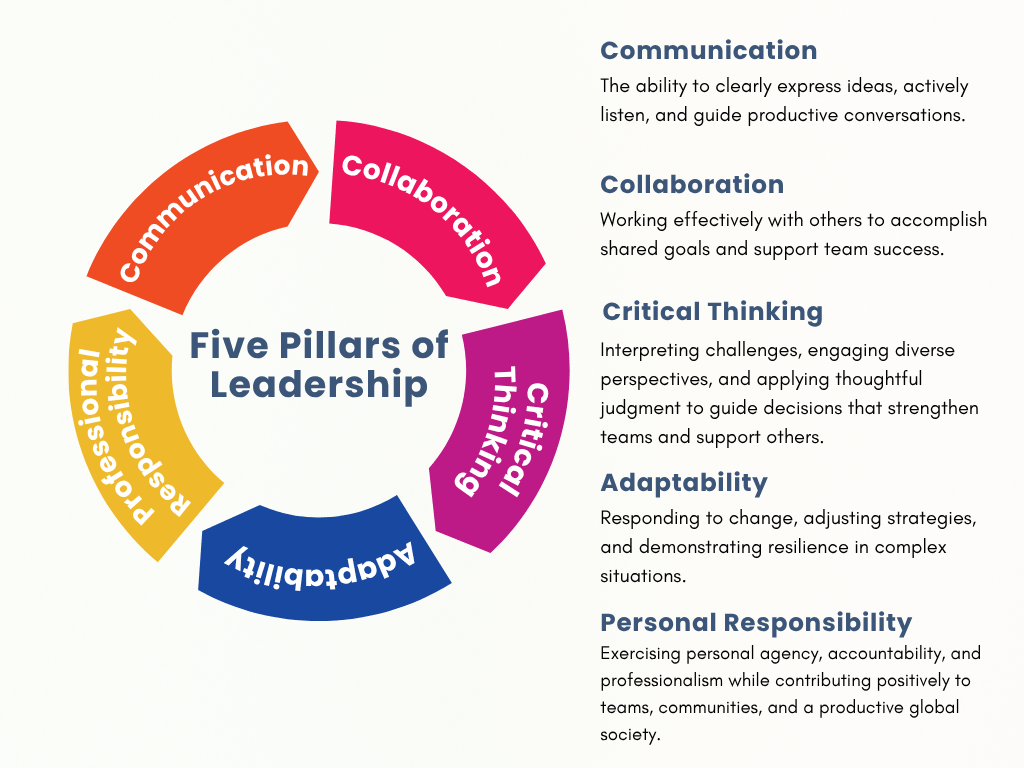
Five Pillars of Leadership
In today’s world, preparing students for success requires more than teaching content or technical skills. Career and Technical Education (CTE) has done an incredible job evolving to meet workforce demands, equipping students with industry knowledge, certifications, and hands-on experience. But there’s still a gap.
Not a gap in what students know. A gap in how they show up.
Because the truth is: We are not just workers, we are human beings navigating relationships, environments, pressure, and expectations. And that’s where many students struggle.
According to a 2025 workforce readiness report, 84% of hiring managers say most high school graduates are not prepared for the workforce, and nearly all emphasize skills like communication, collaboration, and decision-making as essential. It’s not that students can’t do the job. It’s that they struggle with:
- Communicating clearly
- Navigating team dynamics
- Adapting to feedback and change
- Leading themselves and others in real environments
This is exactly why the Ignite CTE Leadership Curriculum was designed. Not to replace technical education, but to complete it.
To serve as a bridge between:
- Content mastery
- Technical skill development
- Human-centered leadership and workplace readiness
Because success isn’t just about what you can do. It’s about how you do it, with and through other people.
From Learning Skills to Living Them
One of the biggest misconceptions in education is that if we teach a skill, students will automatically develop it. But leadership doesn’t work that way.
Skills like communication, collaboration, and adaptability are not built through exposure, they are built through:
- Practice
- Reflection
- Real responsibility
In fact, research shows that 85% of employers believe these “durable skills” are learned through experience, not traditional coursework.
That’s why our model goes beyond instruction.
We don’t just teach leadership. We create systems where students practice leadership in real environments, consistently.
So they don’t just enter spaces ready to participate…
They enter ready to shape the climate and culture of those spaces.
The Five Pillars of Leadership
At the core of the Ignite CTE Leadership Curriculum are the Five Pillars of Leadership, five essential skill sets that prepare students not just for careers, but for life.
1. Communication
The ability to express, listen, and connect with intention
What it looks like:
- Active listening
- Clear verbal and written communication
- Reading the room and adjusting tone
- Giving and receiving feedback
Why it matters:
Communication is the foundation of every environment—teams, workplaces, relationships. Yet it’s one of the most cited gaps by employers.
Students who master communication:
- Build trust faster
- Reduce conflict
- Advocate for themselves and others
Without it, even the most technically skilled individual struggles to succeed.
2. Collaboration
The ability to work effectively with others toward a shared goal
What it looks like:
- Teamwork and shared responsibility
- Conflict navigation
- Respecting diverse perspectives
- Holding others accountable
Why it matters: Work is no longer individual, it’s interconnected.
Students must learn not just how to contribute, but how to co-create.
Students who develop collaboration:
- Strengthen team performance
- Build inclusive environments
- Learn to lead with others, not over them
3. Adaptability
The ability to adjust, grow, and respond to change
What it looks like:
- Navigating uncertainty
- Responding to feedback
- Managing emotions under pressure
- Staying solution-oriented
Why it matters: The workplace is constantly evolving. Roles change. Expectations shift.
Students who are rigid struggle. Students who are adaptable thrive.
This pillar helps students move from: “I can’t do this” → “I can figure this out”
4. Critical Thinking
The ability to analyze, problem-solve, and make informed decisions
What it looks like:
- Asking thoughtful questions
- Evaluating information
- Solving real-world problems
- Making decisions with awareness of impact
Why it matters: Employers consistently rank critical thinking as one of the most important (and hardest to find) skills.
Students who develop this pillar don’t wait for answers but rather create solutions for the challenges they face.
5. Personal Responsibility
The ability to lead yourself with accountability, ownership, and integrity
What it looks like:
- Time management
- Follow-through
- Goal setting
- Taking ownership of actions and outcomes
Why it matters: This is the pillar that activates all others.
Without personal responsibility:
- Skills don’t translate into action
- Potential doesn’t become performance
Students who master this pillar show up consistently for themselves and others. They build trust and become dependable leaders in any space.
From Participants to Culture Leaders
The goal of the Ignite Leadership Curriculum isn’t just to help students succeed individually.
It’s to prepare them to impact the environments they enter.
When students consistently practice these five pillars:
- They don’t just adapt to culture
- They create it
They become:
- The student who includes others
- The teammate who steps up
- The employee who leads without being asked
- The person others trust
The Future of CTE: Skills in Action
CTE is already preparing students for careers. The next evolution is preparing them for people-centered environments within those careers. Because at the end of the day:
- Every job is a people job
- Every environment is relational
- Every opportunity requires more than knowledge
It requires leadership.
And leadership isn’t a role students wait for. It’s a skill set they build.