

When Everything Feels Urgent: A Time Framework Every Educator Should Know
We recognize the growing needs of students.
If you’re here, you’re someone who sees young people as whole humans — carrying academic demands, emotional realities, relationships, responsibilities, and enormous potential. You care deeply.
But caring deeply doesn’t create more hours in the day.
Educators today are balancing instruction, student needs, communication with families, initiatives, meetings, and constant problem-solving. It’s easy to end the day feeling busy but not always sure the right things received your attention.This dilemma invites more than productivity, but rather aligned time management.
When it feels like there’s never enough time, we don’t just need better effort — we need better clarity about where our time is going.
One of the simplest frameworks for doing that comes from leadership thinker Stephen Covey.
Time Management Is Really Priority Management
In The 7 Habits of Highly Effective People, Stephen Covey introduced a powerful idea:
Effectiveness is not about doing more. It’s about doing what matters most.
Covey challenged the traditional idea of time management. Instead of simply organizing tasks, he encouraged people to think about importance vs. urgency.
Many of us spend our days responding to what feels urgent:
-
Emails
-
Interruptions
-
Last-minute requests
-
Deadlines
-
Problems that suddenly need attention
But urgency does not always equal importance.
To help leaders see this clearly, Covey introduced what is now known as the Urgent vs. Important Matrix.
The Four Quadrants of Time
The framework divides work into four categories based on two simple questions:
-
Is it urgent?
-
Is it important?
These questions create four quadrants that reveal how our time is actually being used.
Once you see your work through this lens, it becomes much easier to understand why some days feel productive — and others feel exhausting.
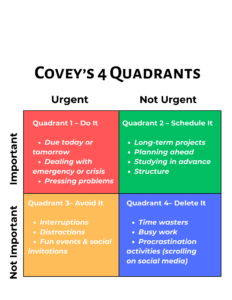 Quadrant 1: Urgent & Important
The “Do It Now” Zone
Quadrant 1 includes the tasks that require immediate attention.
Examples might include:
-
Deadlines due today
-
A student situation that needs immediate support
-
A schedule breakdown
-
A problem that cannot wait
These responsibilities matter and they are time-sensitive. They deserve attention.
But when most of our time lives in this quadrant, work starts to feel like constant firefighting. Every day becomes reactive.
Quadrant 3: Urgent but Not Important
The Distraction Zone
This quadrant is where many people unintentionally lose their focus. The work feels pressing, but it doesn’t necessarily move your most important goals forward.
Examples include:
-
Frequent interruptions
-
Some meetings
-
Notifications and messages
-
Requests that don’t align with your priorities
Because these tasks appear urgent, they easily crowd out more meaningful work.
Quadrant 4: Not Urgent & Not Important
The Time Drains
Every day includes activities that quietly consume time without adding much value.
This might include:
-
Busy work
-
Habitual tasks that aren’t necessary
-
Excessive scrolling or digital distractions
Everyone needs moments to reset and recharge. But when too much time falls into this quadrant, it slowly steals attention from the work that truly matters.
Quadrant 2: Important but Not Urgent
Where the Most Meaningful Work Happens
Quadrant 2 is the most powerful (and often the most overlooked) part of this framework.
These are the things that matter deeply but rarely demand immediate attention:
-
Planning ahead
-
Preparing lessons thoughtfully
-
Professional learning
-
Building systems that make future work easier
-
Investing in relationships with students and colleagues
-
Reflecting on what is working and what could improve
This work doesn’t usually feel urgent in the moment, but it’s the work that makes everything else easier later.
When educators consistently invest time here, they experience less chaos, more clarity and general wellbeing in the future.
The Real Time Shift
The goal of this framework isn’t to eliminate urgency. Schools will always include moments that require immediate response. The real shift happens when we begin to protect time for Quadrant 2 work — the planning, preparation, and reflection that keeps important things from becoming urgent later.
In other words: When we invest time early in the work that matters most, we spend less time reacting later. Instead of constantly chasing the next urgent task, we begin moving forward with more intention.
Turning Insight Into Practice
Frameworks like this are powerful because they give us a moment to pause and rethink how our time is being used.
For educators especially, the day fills quickly with things that demand attention. Without intention, urgency tends to take over. But when we start to recognize where our time is going, we gain the ability to make small shifts that protect what matters most. Sometimes that shift is personal, other times it becomes something we model for students.
At Ignite, ideas like this often become starting points for conversations with young leaders. When students begin thinking about how they use their time, how they set priorities, and how they respond to what feels urgent, they’re beginning to practice leadership in real ways.
If this framework resonates with you, Spark explores ideas like this with students through short, mentor-led lessons designed to build reflection, discussion, and real leadership habits.